
Overton Projected Release Dates
Tennessee records use several dates that sound alike. A release eligibility date marks when parole consideration may become possible under the governing sentence law. It does not order release. A sentence expiration date reflects the agency's calculation of the sentence end. A projected or probable release date, when a record displays one, is an estimate based on the sentence structure and credits then posted. The actual release date records the completed custody event.
For Overton County, first identify who holds the person. A pretrial detainee at the Overton County Jail usually has no sentence-based projected date. Bond, dismissal, a court order, another hold, or later sentencing can change the path. A locally sentenced person depends on the filed judgment, jail credit, and sheriff's calculation. A TDOC-sentenced person may have date fields in the state record. A transfer ends county custody but is not a community release.
| Date label | Meaning | Best source |
|---|---|---|
| Release eligibility date | Possible parole-consideration milestone | TDOC sentence record and controlling law |
| Sentence expiration | Calculated end of the sentence | TDOC or responsible local custodian |
| Projected or probable release | Current administrative estimate, where shown | Exact field on the agency record |
| Actual release date/time | Completed custody event | Sheriff or institution release record |
Find Overton Release Date Records
A defensible search begins with the sentence, not mental arithmetic. Collect the full name, case number, booking or jacket number, and TOMIS ID when each is lawfully known. Keep local and state identifiers labeled. Then identify every count, offense date, sentence length, range, concurrent or consecutive structure, and jail-credit entry in the judgment. “Concurrent” means terms run together. “Consecutive” means one term follows another.
- Confirm whether the person is pretrial, serving a county term, or under a Tennessee felony sentence.
- Get the filed judgment and amendments from the Overton County Circuit Court Clerk.
- For a local term, ask the sheriff for the current sentence calculation, lawful credit entries, holds, and projected date if an existing record contains one.
- For a state term, search official FOIL and transcribe every date label exactly.
- Identify the controlling release-eligibility statute and credit rules by offense date and sentence category.
- Check later judgments, detainers, forfeited or restored credits, revocation, and parole action.
- Date the calculation. After release, obtain the facility's actual release event or authorization.
The clerk is at 1000 John T. Poindexter Drive, Livingston, TN 38570, and lists (931) 823-2312 with weekday hours from 8:00 a.m. to 4:30 p.m., open through lunch. The court file explains the legal sentence. It may not show the moment jail staff completed release or a hold applied by another agency.
Note: A court order authorizes a result, while the custodian's event record shows when the physical release or transfer was completed.
Overton State Release Date Lookup
As observed August 2, 2026, TDOC Felony Offender Information Lookup, or FOIL, covers felony offenders currently or formerly in state custody or supervision. It can show a photograph, status, location, offenses, sentence information, parole-hearing status, and release information. A person released only from the Overton County Jail may never appear. Conversely, a state-sentenced person can appear while housed locally.
The live form provides three routes. Search by Name includes Last Name, First Name, Race, and an option to include aliases. Identifier searches accept a TDOC or TOMIS ID and a State ID Number, called SID. A CAPTCHA is required. Open the right detail record and write down the status, sentence fields, release fields, and observation date. Do not promise a universal “projected release date” field because labels vary by record.
| FOIL control | Input | Use |
|---|---|---|
| Search by Name | Last name, first name, race, alias option | Find candidates, then compare identifiers and photo |
| TDOC/TOMIS ID | State corrections identifier | Strongest direct route when known |
| State ID Number | SID | Alternate identifier route |
| CAPTCHA | Required live challenge | Must be completed to submit the search |
The official FOIL search form was captured with its blank inputs.
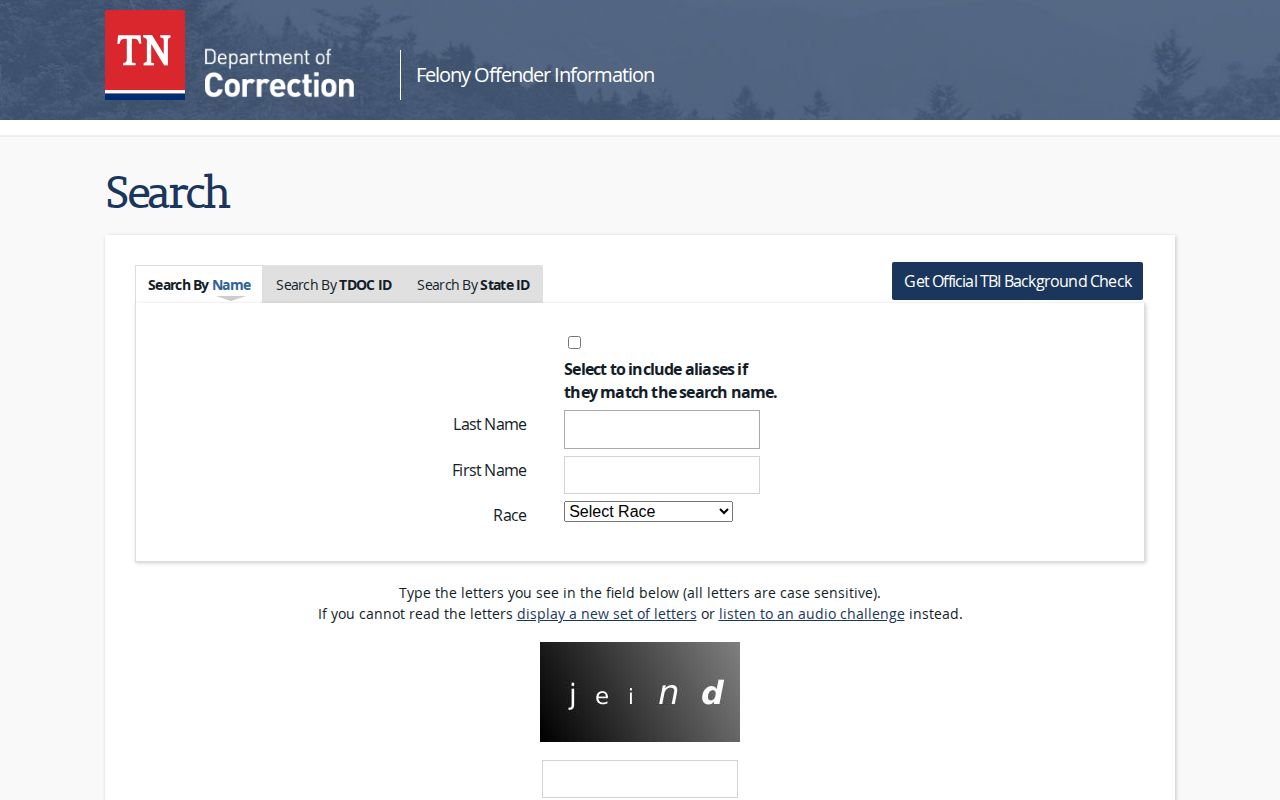
The screenshot supports the search controls, not any individual's date. A detail record should be captured only with unneeded personal data minimized, then dated because it has no dependable permanent result link.
Overton Release Percentages Explained
Tennessee does not have one universal 85 percent rule. Official judgment instructions illustrate several statutory categories, including 20, 30, 35, 45, 60, 70, 75, 85, and 100 percent. The correct category depends on the conviction, offense date, classification, judgment, exclusions, and current version of Tenn. Code Ann. § 40-35-501. A percentage can define eligibility treatment without promising a release date.
For specified offenses within subsection (i), a 100 percent service rule may let sentence-reduction credits reduce service by no more than 15 percent. That is the source of the common 85 percent shorthand. It is not a statewide default. Other offenses and truth-in-sentencing provisions for later offense dates can require different treatment. The judgment and controlling subsection must be checked before applying any percentage.
A release eligibility date remains consideration eligibility. The Board may deny, defer, or condition a grant, and a grant may require an approved plan and processing. Post-release supervision is a later status, not another name for the eligibility field. Keep the Board decision, field-office assignment, and physical release record separate.
Overton Sentence Credits and Release
Sentence-reduction credits for qualifying state prisoners are governed chiefly by Tenn. Code Ann. § 41-21-236. Eligibility, behavior, program criteria, forfeiture, and the applicable sentence law all matter. Credits may affect a sentence calculation without moving parole eligibility in the way a reader expects. A disciplinary forfeiture, later restoration, or corrected entry can change the displayed date.
County-jail credits and work or program credits have separate authority and local administration, including Tenn. Code Ann. §§ 41-2-111 and 41-2-146 when applicable. Pretrial jail credit must also be entered and reconciled from the judgment. Do not import another Tennessee county's local credit policy into Overton. No published Overton jail good-time table was found.
- Jail credit
- Time the judgment credits against the sentence for qualifying pretrial confinement.
- Sentence-reduction credit
- A credit governed by law and agency rules that may affect a qualifying state sentence.
- Release eligibility
- The point at which parole consideration may be allowed, not a release promise.
- Detainer
- A request or legal hold from another authority that may prevent community release.
- Discharge
- The formal end of a custody or supervision obligation shown in the responsible agency's record.
Why Overton Release Dates Change
A date can move for a sound legal or record reason. Ask which source changed, when it changed, and whether the new field is eligibility, expiration, projection, or actual release. Never overwrite an earlier value without preserving its date and agency label.
| Change | Possible effect | Record to check |
|---|---|---|
| Corrected judgment or added jail credit | Recalculates sentence dates | Filed amended judgment and custodian calculation |
| Credits earned, forfeited, or restored | Moves a projected or expiration field | TDOC or jail credit ledger |
| Consecutive sentence | Adds a term after another | Judgment and sentence computation |
| Parole action | Changes eligibility path or planned release | Board action and FOIL status |
| Detainer or hold | Can block community release or cause transfer | Facility release and receiving-agency entries |
| Revocation or new process | Returns a person to custody or changes the term | Court, Board, and TDOC records |
A future date should always carry an “as of” date. If it changes, report the new field with its source rather than calling the old record false. Calculations can be revised after a judgment, credit, appeal, or new custody event.
Once a planned date is close, the Overton County VINELink inmate search can register for a reported custody change. An alert does not confirm the calculation. It provides a prompt to ask the sheriff or TDOC for the actual event and any receiving agency.
Overton Jail Date Calculations
No published Overton County good-time table or weekend-release rule was located. That absence makes the local route document-driven. Obtain the judgment and its jail-credit language from the clerk. Then ask the sheriff for the final release calculation and event record. Information about an inmate's “time” is given only to the inmate under the sheriff's public visitation guidance, so a third party should not expect a telephone estimate.
Use § 40-35-501 and TDOC sentence fields only when the relevant sentence is a state sentence. A short county term may never create a FOIL record. Ask for an existing calculation rather than demanding that staff perform new arithmetic. A narrow request can identify the booking, case, judgment date, credited time, release field, holds, and the actual event after it occurs.
Note: Overton County's lack of a public calculation table is not proof that the jail keeps no internal sentence or release records.
Prove Overton Actual Release
The final proof comes from the responsible custodian. For a county case, obtain the sheriff's release date and time, reason or authority, and destination. Pair it with the operative court judgment or order. If the destination is TDOC or another agency, continue the chain rather than calling the event freedom from all custody.
TDOC Policy 511.03 names two institutional records worth requesting when releasable: Release Authorization CR-1947 and Release Checklist CR-3835. The policy covers release paths such as probation, parole, mandatory parole, pardon, sentence expiration, court order, and bond. A historical request can seek those forms, actual release date and type, and the expiration or discharge entry. Personal or operational fields may be redacted.
The TDOC FOIL description page explains the current and former offender scope and public information categories.
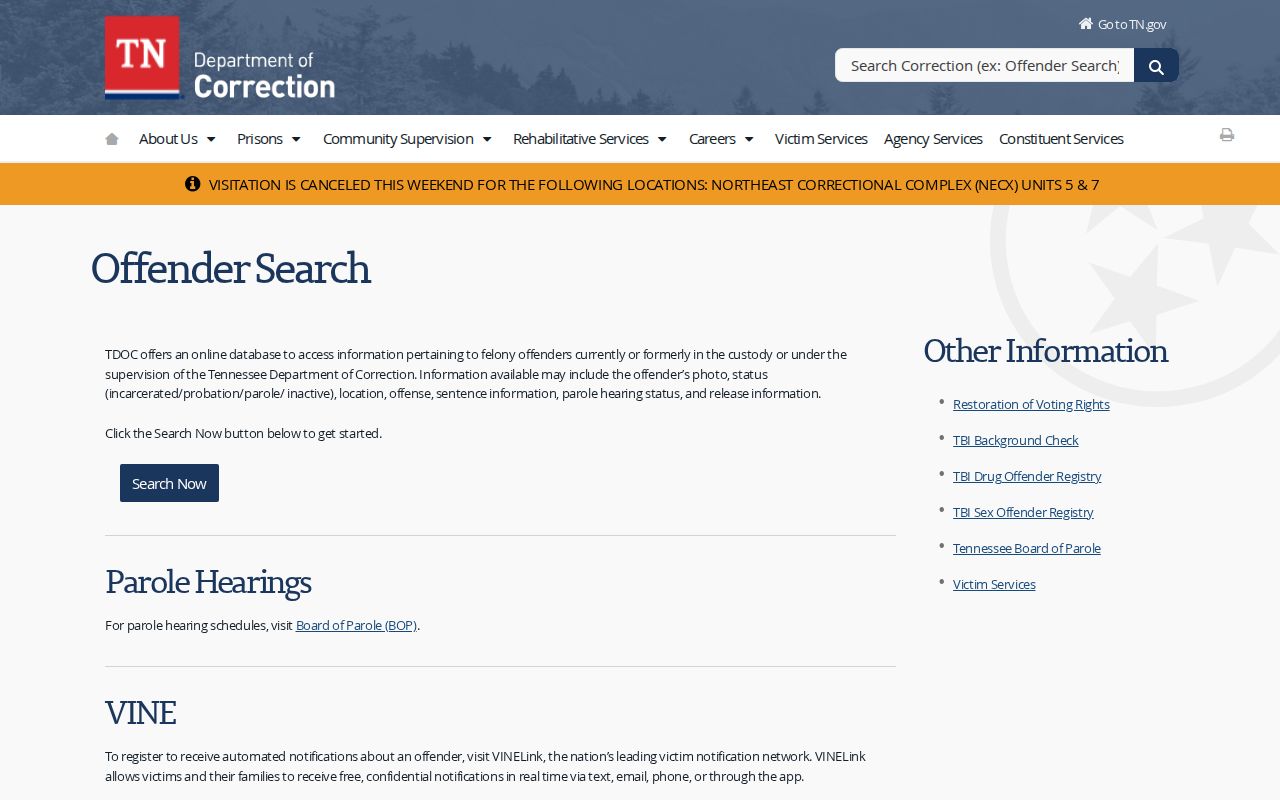
The captured state source shows why FOIL can remain useful after state release. Its web display is still a locator. A disputed date should be resolved with the underlying authorization, checklist, sentence computation, and final event.
For an older file, use the TDOC Archived Record Request. Include the person's full name, TOMIS ID, date of birth or other available identifier, and an exact record description. TDOC says archive-search charges may apply and instructs requesters not to send payment with the first request.
FOIL also warns about completeness and timeliness. Treat the result as a locator and current public summary. If an inactive record lacks the needed calculation, request the sentence computation, credit history, release or discharge dates, and named release forms for the relevant term. Keep the response with the court judgment and actual release record. Together they show what was ordered, how the agency calculated the term, and when custody ended.
The full Overton County released inmates search helps when the event may belong to the county jail, TDOC, a court, or another receiving agency instead of the projected-date source first checked.