
Overton Parole and Probation
Tennessee separates the power to grant parole from the work of field supervision. The Tennessee Board of Parole conducts hearings and makes parole release decisions. The Tennessee Department of Correction, or TDOC, supervises people placed on parole, probation, determinate release, and other community programs. A county court may order probation. The Board may grant parole on an eligible state sentence. Neither label means the sentence or case has vanished.
A person released from the Overton County Jail may have no TDOC supervision at all. A bond release can leave a case pending without creating probation. A transfer can end Overton custody while another agency still holds the person. For a state felony record, TDOC Felony Offender Information Lookup, known as FOIL, is the useful first check. Read its status alongside the court judgment and any release event.
| Point | Parole | Probation |
|---|---|---|
| Who authorizes it | Tennessee Board of Parole | A court through its judgment or later order |
| When it starts | Conditional release before sentence expiration | As a court-ordered community sentence or after a split sentence |
| Who supervises | TDOC Community Supervision | TDOC Community Supervision when assigned |
| Best public starting point | FOIL status and parole fields | FOIL status plus the filed probation order |
| Proof it ended | TDOC discharge or sentence record | Discharge or court/TDOC completion record |
Verify Overton Post-Release Supervision
Identity comes first. FOIL covers felony offenders currently or formerly in TDOC custody or supervision, but an Overton County booking alone does not guarantee a FOIL entry. Search by a TOMIS identifier when it is known. For a name search, compare the displayed photo and lawful identifying facts. Copy the exact words used for status, location, parole hearing information, and release information. “Inactive” does not state why supervision ended and must not be translated into a court outcome.
- Open the official FOIL landing page and enter the TOMIS ID or the full name. Narrow the match with the fields the live form supplies.
- Open the correct detail record. Record the displayed status and lookup date without changing the agency's wording.
- Check whether a supervising office or location is shown. Compare that assignment with the current TDOC field-office directory.
- For probation, obtain the filed judgment or probation order from the Overton County Circuit Court Clerk. It states the court's terms more clearly than a locator summary.
- Contact the assigned office for an authoritative reporting instruction or status check. Do not choose an office from residence alone.
The court file and TDOC record answer different questions. The court judgment supplies the legal sentence. FOIL provides a public state status and navigation path. A field office holds the current supervision assignment. When dates conflict, preserve both labels and ask the office or records custodian for the source entry.
Note: Date every FOIL and office-directory observation because assignments, statuses, and public interface fields can change after the first search.
Overton Supervision Uses District 31
As of August 2, 2026, Overton County is listed in TDOC Community Supervision District 31. The same district also serves Clay, DeKalb, Jackson, Macon, Pickett, Putnam, Smith, and Trousdale counties. This regional structure explains why an Overton resident may be told to report in Cookeville instead of a county-branded Livingston office. The live FOIL assignment and directory still control. Check them before travel.
TDOC Community Supervision District 31
851 S. Willow Avenue, Suite 202
Cookeville, TN 38501
Phone: (931) 526-7165
Fax: (931) 528-3267
No verified county-run parole office was found in Overton County. TDOC Community Supervision performs the field work, while the Board of Parole handles parole decisions. The district address is useful for routing, not proof that it is the person's assigned reporting site. A transfer, special condition, or later reassignment can point elsewhere.
Overton Parole Hearing Records
A scheduled hearing is not a release order. The Board's hearing officers conduct proceedings for eligible people in TDOC institutions and county jails, then make nonbinding recommendations. A parole grant may still depend on an approved release plan and administrative processing. Overton County Jail appears on the Board's county-jail hearing schedule, which matters when a state-sentenced person remains housed locally.
The current schedule fields include facility, TOMIS number, name, hearing type, and date. The county-jail hearing schedule changes. The Board says schedules update each Monday, or Tuesday after a Monday holiday. Requests may be sent to BD.HearingSchedules@tn.gov, and schedule verification is available at (615) 741-1150. As of August 2, 2026, no separate statewide public final-results database had been verified in the project research.
The official Parole Hearings Division page shows how schedules are organized and how a hearing fits within the Board process.
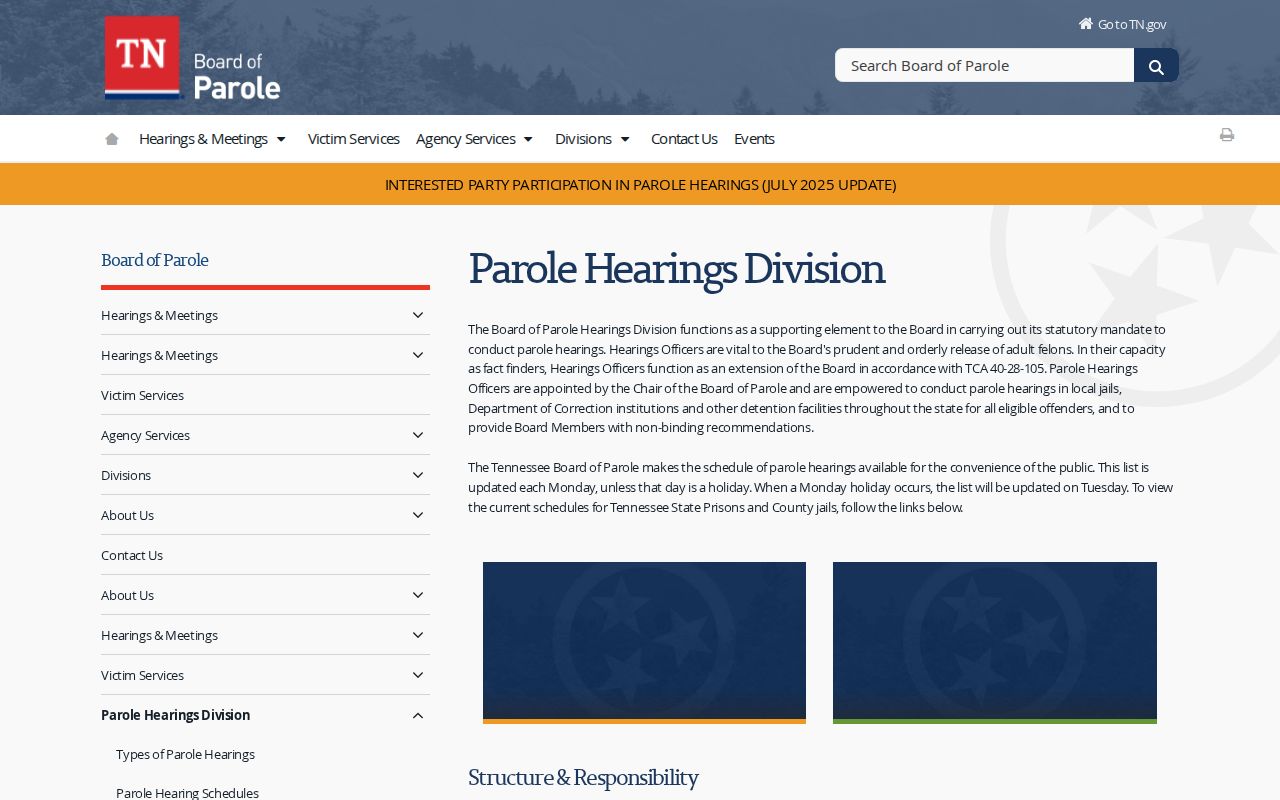
The captured state page supports the route to hearing information, but only the current schedule and later agency record can establish what happened in a specific case.
Overton Supervision Terms Defined
Short labels can hide important differences. These definitions keep an Overton County release record, state status, and court order in the proper lane.
- Parole
- Conditional release authorized by the Board before a state sentence expires, with the rest served under supervision.
- Probation
- A court-ordered community sentence subject to stated conditions, sometimes used without a prison term or after a split sentence.
- Determinate release
- A statutory probation form for qualifying sentences under Tennessee law.
- Absconder
- An agency or legal status tied to an alleged failure to remain under supervision. It is not a guess based on a missing address.
- Revocation
- A formal process that may change or end community supervision after an alleged violation.
- Discharge
- The formal end of a custody or supervision term shown by the responsible agency's record.
Overton Violations and Absconder Status
Conditions vary by judgment and supervision type. They may govern reporting, travel, treatment, payments, or conduct, but a public summary is not the person's full case plan. An alleged breach does not establish the final result. Revocation proceedings can include preliminary and final hearings, a recommendation, Board or court action, and outcomes such as reinstatement or revocation.
No official Overton County-specific absconder list was identified. Check FOIL, the assigned TDOC office, and the court or official warrant channel when that question has a lawful reason. Do not repeat a social post or an unverified claim as agency status. A VINELink custody alert can report a later custody event, but it does not replace the supervision record.
Jacket Numbers Support Overton Records
The Overton sheriff's visitation guidance says booking can provide an inmate jacket number. That local identifier can separate similar names when seeking a booking record or photo after release. It does not replace the TOMIS number used in state records. Put each number beside its issuing agency so the records are not merged by mistake.
The same sheriff guidance says information about an inmate's “time” is given only to the inmate. A disputed release calculation should therefore move through the person's own papers, the filed judgment, and a narrow records request. For state supervision, ask TDOC for the sentence and discharge entries. For the broader county release search and record chain, use the Overton County released inmates search.
Overton Probation and Recovery Court
Overton County Recovery Court is a named local program linked to General Sessions and probation-violation matters. Its individual information describes program eligibility and twice-monthly case-manager visits. Recovery Court may help explain a local court path or condition, but its presence is not proof that a person was released, enrolled, discharged, or found in violation.
Confirm participation through the court record and responsible program source. Keep that result apart from FOIL's state supervision label. One record describes the local judicial program. The other describes TDOC custody or supervision. When supervision ends, seek a formal discharge or completion entry rather than treating the lack of a current web result as proof.
Note: A parole eligibility date, hearing grant, probation order, physical jail release, and final discharge are separate events with separate records.
Overton Supervision Release Types
TDOC's Types of Release material distinguishes several community-supervision routes. Parole is Board-authorized release before sentence expiration. Probation comes from a court. Determinate release is a statutory probation path for qualifying sentences. Community corrections is a court-ordered alternative administered through its assigned structure. Community supervision for life is a separate framework for specified offenses. The label on a specific judgment or FOIL record controls; the terms should not be swapped because they all involve contact with TDOC.
These routes can produce different records. A parole question may require the Board hearing record, release plan, FOIL status, and institutional release authorization. A probation question usually starts with the court judgment and continues with TDOC's supervision entry. Determinate release depends on its statutory criteria. When an Overton County jail event says “probation,” obtain the court order before assuming which office, term, or conditions apply. The county release timestamp proves the jail exit, while the supervision record proves the community status.
Overton Supervision Discharge Proof
Supervision ends through a formal record, not silence on a public page. For an old state file, use the TDOC Archived Record Request and ask for the supervision start, status changes, termination or discharge date, and sentence-expiration entry. Include the full name, TOMIS number, date of birth or other available identifier, and a narrow description. TDOC says archive-search charges may apply and asks that payment not be sent with the initial request.
For court probation, also obtain the filed completion, revocation, or amended order when one exists. A person can leave physical custody, remain on supervision, later be revoked, and finally discharge on different dates. Put each date beside its source. If FOIL and the court file appear to conflict, ask the assigned field office or record custodian to identify which event each field represents rather than collapsing them into one “release date.”